Nondestructive Residual Stress Sensor for Pipeline Damage
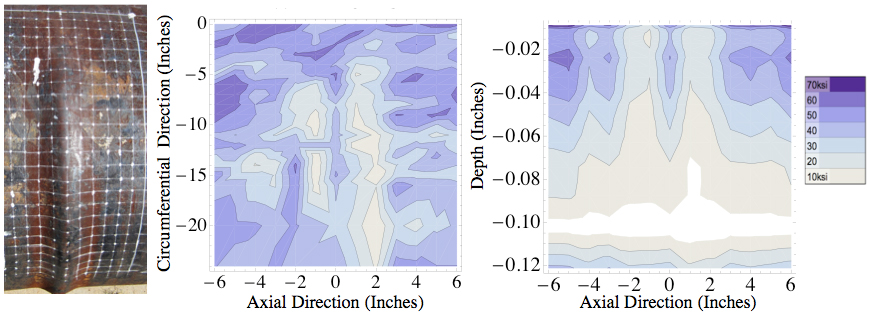
A leap forward in the state of pipeline integrity management is coming in the form of a portable tool for three-dimensional residual stress mapping that was demonstrated through DOT Phase I SBIR research funding. The residual stress assessment technology opens the door to a dramatic change in the way pipeline damage and deformations (e.g. wrinkles, buckles) can be assessed that will improve the accuracy, speed, and value of pipeline inspections. Pipelines are, by far, the most economical form of transportation of gases and liquids but at the same time they form a network of potentially dangerous lines covering our nation that has been extended well beyond its initial design life. New technologies such as the residual stress sensor technology are critical to ensure their safe operation for years to come.
The technology was demonstrated on 8 wrinkle bends and 2 dents with gouges through collaboration with El Paso Corporation, NIST-Boulder, and the NRC Canadian Neutron Beam Centre to perform comparison testing and calibration. The results show similar accuracy and depth as results achieved by neutron diffraction but without the dangers of radiation or requirements for a nuclear source. The rapid, portable nature of the technology and its inherently safe operation provides a valuable and unique new method for 3-D assessment of residual stress in pipelines and other materials.
0 comments