First Principles Based Modeling and Simulation for DoD Applications
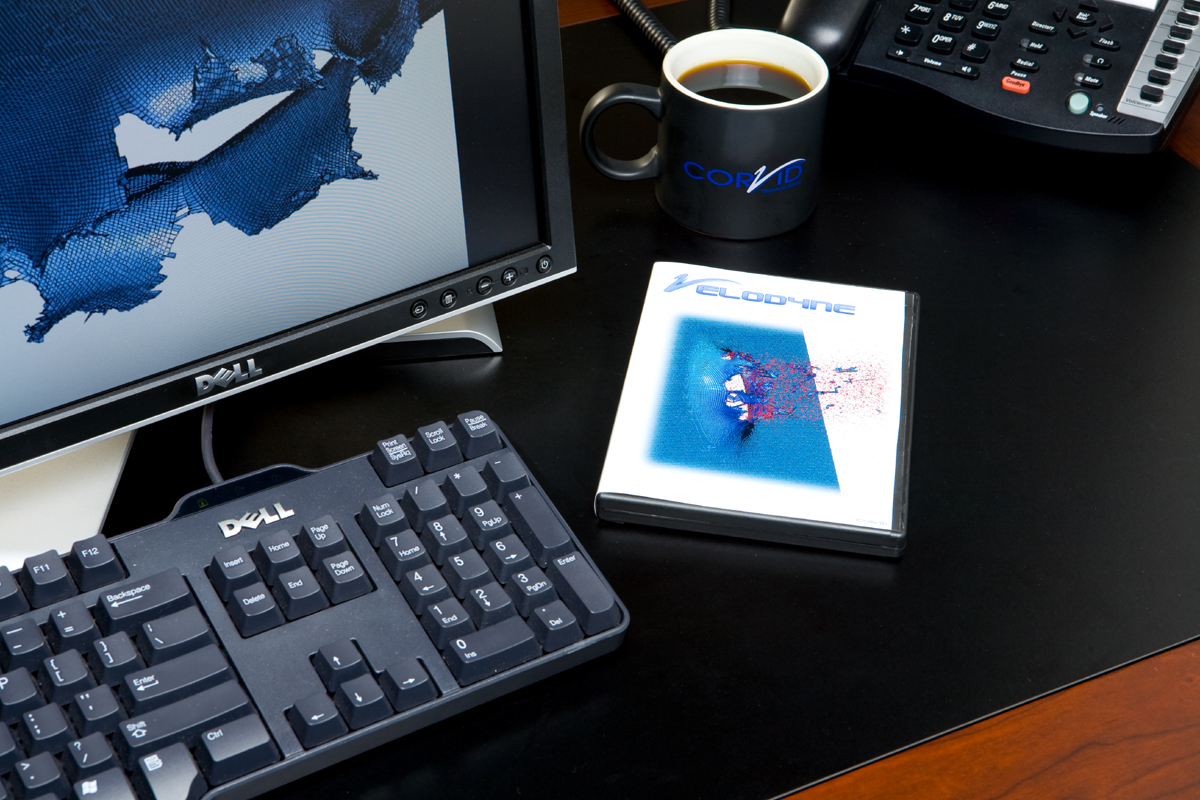
Corvid Technologies was founded in September of 2004 with 5 employees and the vision of providing high fidelity computational physics analysis support to defense and automotive industries. Currently, Corvid has 50 employees and annual revenues in excess of $10 million with offices also in Washington, DC, and Huntsville, AL. Corvid has won 17 Phase I SBIRs transitioning 9 of the 16 eligible to Phase IIs. Corvid has been awarded 5 Enhancements and 2 Phase III contracts.
While Corvid’s customers began with and still include the Missile Defense Agency and General Motors Racing, we have expanded our customer base significantly. Our sponsors now include Redstone Arsenal, the Army and Air Force Research Laboratories, the Naval Sea Systems Command, and the Mine Resistant Ambush Protected (MRAP) Vehicles Joint Program Office (JPO).
Corvid also continues collaborative programs with Sandia and Lawrence Livermore National Laboratories, as well as Textron, Concurrent Technologies Corporation, Raytheon, Lockheed, Northrop Grumman, BAE Systems, and Oshkosh. Corvid also maintains research relationships with a number of small businesses around the country.
Historically, Corvid’s core competencies are high fidelity computational physics such as fluid dynamics, shock wave physics, and structural mechanics. These areas require expertise in material science, aeromechanics, high strain rate physics, and numerical methods. Corvid develops its own computational codes and has shown these to be accurate and predictive across a broad range of problem classes. To provide solutions to our customers we maintain a 4000 cpu massively parallel supercomputer system which allows us to conduct thousands of large scale computations yearly. As such, our methodology is not only predictive, but productive: it is routinely used for parametric studies within weapons design programs.
In 2011, Corvid Technologies received the Tibbetts Award for the design, analysis, construction and flawless operation of a large scale rocket motor slow cook off oven for PAC-3/MSE Insensitive Munition (IM) compliance testing. This highly successful program was driven through computational analysis and leveraged our prototype design and construction capabilities.
For this Tibbetts Award nomination, we will again focus on our use of high fidelity computational physics, but as it applies to the prediction of ballistic missile defense intercepts and their consequences. These efforts have led to the use of computational physics to predict post-intercept debris fields, and subsequent utilization of those debris fields to develop radar algorithms for hit and kill assessment across the Ballistic Missile Defense System. As an extension of the subject SBIR, Corvid’s resources are now also used to predict the response of armored wheeled vehicles, such as the MRAP, to underbody blast attacks by improvised explosive devices (IEDs).
Both MDA and MRAP JPO utilize Corvid Technologies’ high fidelity modeling and simulation approach to predict the performance, effectiveness, and survivability of their systems. Though originally focused on missile defense issues, this work has significantly benefited the armored vehicle community by predicting underbody blast effects on soldiers in the field subjected to IED attacks and providing an intelligent path forward to improved underbody design.
0 comments